
Wearable Health Monitoring
A Pine smartwatch records movement minutes, heart rate, activity-related energy expenditure, and sedentary patterns (total time, bouts, and breaks).
An AI powered tool developed through clinical research and participatory design to reduce secondary complications and improve everyday health for wheelchair users.


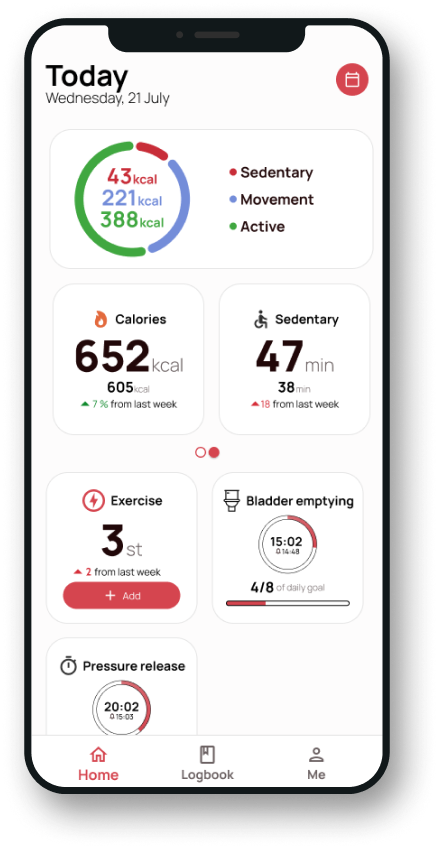
About the Project
Wheelability is a research-driven mobile health application designed for individuals who are wheelchair dependent due to neurological conditions such as spinal cord injury (SCI). The app integrates wearable sensor data, self-reported symptoms, and AI-generated insights to support day-to-day health decision making.
Powered by evidence from more than 650 physiological measurements and participatory design, Wheelability translates complex health data into clear, actionable feedback.
Wheelability is developed in close collaboration between Karolinska Institutet, University of Gothenburg (Appademin), and Ryggmärgsskadecentrum in Stockholm.
The Problem We Aim to Solve
Living with SCI or similar neurological conditions can involve loss of sensory feedback, lower activity levels, and fragmented follow-up routines. Together, these factors can reduce independence, quality of life, and increase healthcare utilization.
Our Solution
Wheelability enables continuous health monitoring and proactive intervention outside the clinic, in everyday life.
A Pine smartwatch records movement minutes, heart rate, activity-related energy expenditure, and sedentary patterns (total time, bouts, and breaks).
Inside the app, users can log pain (nociceptive and neuropathic), pressure relief routines, bladder and bowel management, spasticity episodes, and skin checks.
Generative AI analyzes holistic data to provide personalized recommendations, early warning signals, clear explanations, and behavior-linked insights such as sedentary time plus low pressure relief increasing ulcer risk.
The Wheelability Team
Wheelability combines expertise in SCI rehabilitation, human-computer interaction, AI, behavior change, and participatory design, shaped continuously with end users and clinicians.
Tobias Holmlund, PhD, Assistant Professor, Karolinska Institutet - SCI rehabilitation, energy expenditure research, clinical integration.
Prof. Alexandra Weilenmann (University of Gothenburg) - Interaction design, mobile and wearable technology research.
Mattias Rost, PhD (University of Gothenburg) - Human-centered AI, interaction design.
Dr. Swen Gaudl (University of Gothenburg) - AI, computational systems, wearable technology.
Sebastian Andreasson, Research Engineer - App development and prototyping.
Dr. Vasiliki Mylonopoulou (University of Gothenburg) - Behavior change, participatory design, and technology evaluation for chronic conditions.
Ryggmärgsskadecentrum, Stockholm - Clinical expertise and end user involvement, with a central role in founding the project.
Plus SCI clinicians, physiotherapists, and participating end users shaping the app through co-design workshops.
Contact
We welcome collaboration and questions from rehabilitation centers, clinicians, researchers, and potential pilot participants.
Tobias Holmlund, PhD
Assistant Professor, Karolinska Institutet
Email: tobias.holmlund@ki.se
Phone: +46852488820
Additional contacts:
Mattias Rost, PhD - University of Gothenburg (Human-centered AI, interaction design)
Dr. Swen Gaudl - University of Gothenburg (AI, computational systems, wearable technology)
Sebastian Andreasson - Research Engineer (App development and prototyping)